Retinol, Retinal, Tretinoin: Decoding Vitamin A, The "Gold Standard" of Skincare
If you were stranded on a desert island and could only bring one active skincare ingredient with you, almost every dermatologist would tell you to pack Vitamin A.
But if you have ever stood in the skincare aisle or scrolled through TikTok looking for Vitamin A products, you know it is confusing. You see words like Retinol, Retinaldehyde, and prescription names like Tretinoin thrown around. Are they the same thing? Is stronger always better? Why does one cost £30 and another require a private prescription?
Let’s cut through the noise and decode the family of Vitamin A so you can choose the right player for your skin.
The Basics: It’s All In The Family
First, you need to understand that "Vitamin A" in skincare isn't just one single molecule. It is a whole family of compounds known collectively as Retinoids.
While they have different names and strengths, every retinoid has the exact same goal: to communicate with your skin cells to make them behave differently.
However, your skin cells only speak one very specific language: Retinoic Acid.
This is the key to understanding the difference between all the products out there.
If you apply pure Retinoic Acid to your skin, your cells understand the instructions immediately.
If you apply other forms of Vitamin A, your skin has to do some work, converting that molecule into Retinoic Acid, before it can have any effect.
The number of "conversion steps" required determines how strong, how fast, and how irritating a product will be.
The Strength Ladder: The 3 Main Players
Think of this as a ladder of potency. The conversion process takes time, and with each step, the ingredient becomes slightly gentler on the skin.
1. The Slow & Steady: Retinol
Conversion Steps: Two.
The Lowdown: Retinol is the most common over-the-counter (OTC) form. When applied, your skin must first convert it into retinaldehyde, and then convert that into retinoic acid. Because of this two-step delay, it releases slowly into the skin.
Examples:
La Roche-Posay: A fantastic entry point found in most high-street pharmacies. Their Retinol B3 Serum is widely loved for being gentle on sensitive skin.
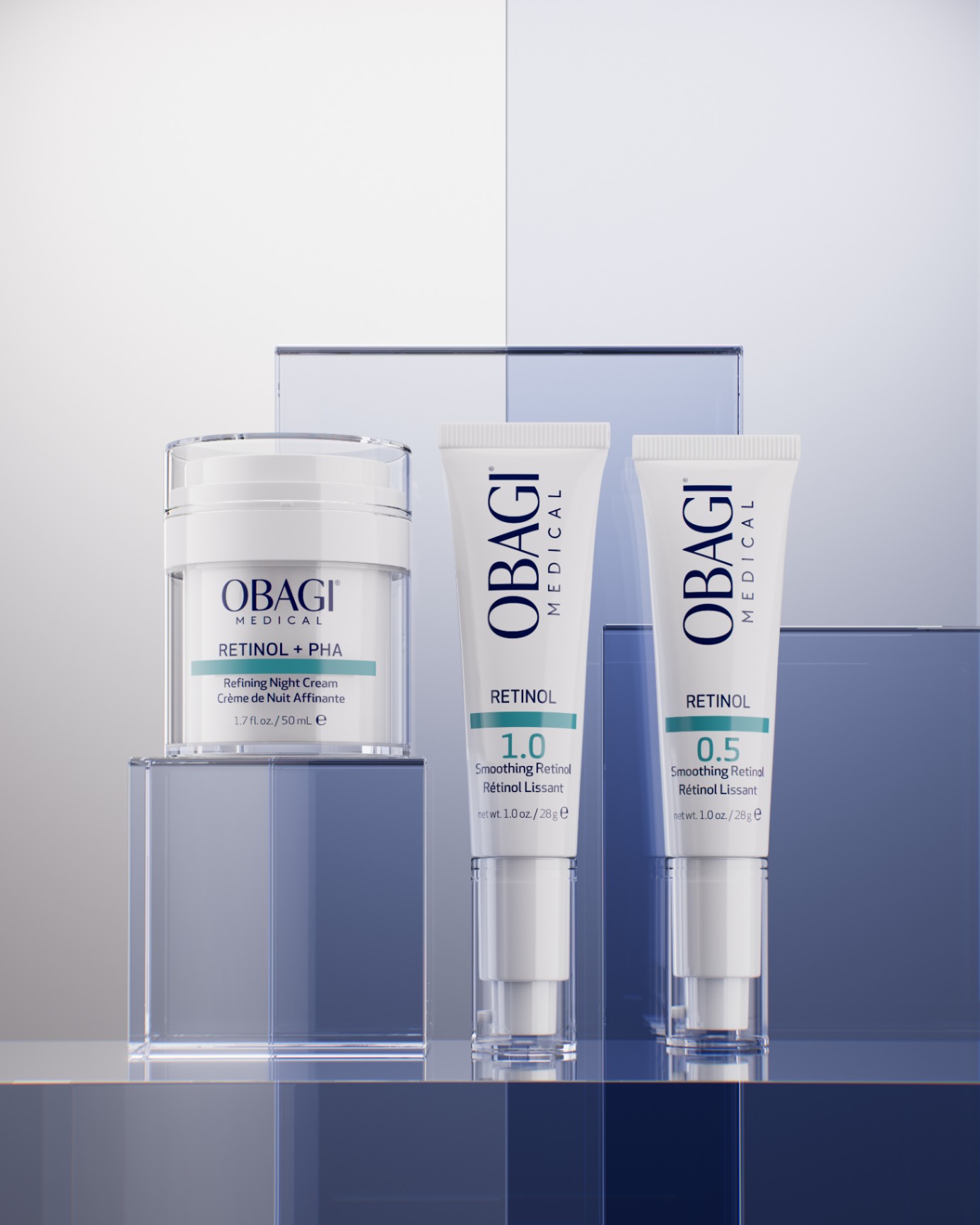
Obagi Medical: For a more clinical approach, Obagi offers step-up strengths with their Retinol 0.5 and Retinol 1.0 creams. These use entrapped retinol for gradual release, minimizing irritation.
Obagi Retinol + PHA: For those wanting a multitasker, the Obagi Retinol + PHA Refining Night Cream is a newer innovation. It combines retinol with Polyhydroxy Acids (PHAs) to gently exfoliate the skin surface while the retinol works deeper, refining texture without the harshness often associated with acids.
Best For: Beginners, younger skin looking for preventative measures, or those with sensitive skin who need a gentle introduction.
2. The Middle Ground: Retinaldehyde (Retinal)
Conversion Steps: One.
The Lowdown: Retinal is the direct predecessor to retinoic acid. It only takes one step for your skin to activate it. This means it works significantly faster than traditional retinol, with some studies suggesting up to 11 times faster, but it is generally still well-tolerated. It is also known for being antibacterial, making it great for acne-prone skin.
Examples: Formulating with Retinal is difficult, so you often find it in high-end clinical lines. Obagi features this in the SUZANOBAGIMD™ Retivance® Skin Rejuvenating Complex. This formula combines Retinaldehyde with peptides and antioxidants to improve skin texture and reduce signs of ageing with little-to-no downtime.
Best For: People looking to upgrade from retinol for faster results without jumping straight to prescription strength.
3. The Powerhouse: Tretinoin
Conversion Steps: Zero.
The Lowdown: This is pure Retinoic Acid. It does not need to be converted. As soon as it touches your skin, it starts working. In the UK, this is a prescription-only medicine (POM).
Examples: You cannot buy this off the shelf. It is only available through approved Obagi clinics, dispensed by medical professionals such as here at DG Medical Aesthetics and Skin. Obagi is famous for their prescription-strength Tretinoin creams and gels (ranging from 0.025% to 0.1%), which are frequently prescribed as part of the Nu-Derm® System.
Best For: Significant acne, deeper wrinkles, and severe sun damage.
How Do They Actually Work?
Why do we put ourselves through this confusion? Because the results are worth it. Think of retinoids as a boot camp for lazy skin cells.
They Speed Up Cell Turnover: They trick your skin into thinking it is younger, causing dead surface cells to shed faster and new, fresh cells to rise to the surface. This leads to the famous "retinol glow."
They Boost Collagen: They dive deep into the dermis to stimulate fibroblasts (the collagen-making factories), which helps firm the skin and reduce fine lines over time.
They Keep Pores Clear: By regulating cell turnover, they prevent dead skin cells from clumping together and clogging pores, which is a primary cause of acne.
The Reality Check: The "Retinoid Uglies" and Tretinoin Tolerance
With great power comes potential irritation. Retinoids are notorious for a period of adjustment known colloquially as the "Retinoid Uglies."
When starting any retinoid, it is common to experience:
Dryness and flaking
Redness and sensitivity
A stinging sensation when applying other products
"Purging" (a temporary flare-up of acne as trapped congestion surfaces rapidly)
Usually, your skin adjusts after a few weeks, and these side effects subside. This process is called "retinisation."
The Hard Truth About Tretinoin
Because Tretinoin hits the skin with zero buffer, it is profoundly potent. While the results can be incredible, many people find Tretinoin exceedingly difficult to tolerate.
There is a misconception that you must "graduate" to Tretinoin to have "perfect" skin. This is false. If Tretinoin leaves your skin chronically red, peeling, and with a damaged moisture barrier, it is doing more harm than good. A chronic state of inflammation is actually pro-ageing.
Consistency beats intensity. Using a well-formulated Retinaldehyde (like the Suzan Obagi Retivance) or a Retinol 1.0 every single night without irritation will yield better long-term results than using prescription Tretinoin once a week because your face hurts too much to use it more often.
How to Start Safely: The Golden Rules
Ready to introduce Vitamin A into your routine? Do not rush it.
Start Low and Slow: Do not apply it every night right away. Start with 2 nights a week for two weeks. If your skin is happy, bump it up to every other night.
Nighttime Only: Sunlight degrades most forms of Vitamin A, rendering them less effective. Keep them in your PM routine.
The "Sandwich Method": If you have sensitive skin, apply a light layer of moisturiser first, let it dry, apply your retinoid (a pea-sized amount is enough for the whole face!), and follow with another layer of moisturiser. This buffers the penetration and reduces irritation.
SPF is Non-Negotiable: Retinoids reveal fresh, new skin cells that are highly susceptible to UV damage. You must wear sunscreen every single day during the day, or you are undoing all your hard work.