
Acne and Acne Scarring: Where Laser Fits In (and Where It Doesn't)
Acne is often thought of as a teenage problem, but many of the people we see are in their thirties, forties and beyond. Some are dealing with breakouts for the first time as adults; others are living with the scars acne left behind decades ago. Both can have a real effect on confidence.
Laser and light treatments can help with both active acne and scarring. But this is an area where it is especially important to separate the evidence from the marketing, so here is a balanced guide.
Two different problems
Active acne is an inflammatory condition of the hair follicle and its oil gland. Excess oil (sebum), blocked pores, the bacterium Cutibacterium acnes and inflammation all play a part.
Acne scarring is the legacy of that inflammation. The most common type is atrophic (indented) scarring, where collagen has been lost, leaving rolling, boxcar or ice-pick scars. Discolouration left behind after spots, such as red or brown marks, is not true scarring and often behaves differently.
The two need different approaches, and it is usually best to get active acne under control before focusing on scars.
Laser alongside, not instead of, medical treatment
The National Institute for Health and Care Excellence (NICE) recommends a 12-week course of topical treatment, sometimes combined with oral antibiotics, as the first-line approach for acne in the UK. That remains the foundation. Laser and light treatments can be a valuable addition, particularly for people who want to reduce reliance on long-term medication, cannot tolerate certain treatments, or want to address texture and scarring at the same time.
As nurses, we will always ask about your acne history and current treatment, and if your acne is moderate to severe, painful, or scarring, we will encourage you to see your GP as well.
The technology we use
Our Alma Harmony platform gives us several approaches that can be combined in a personalised plan.
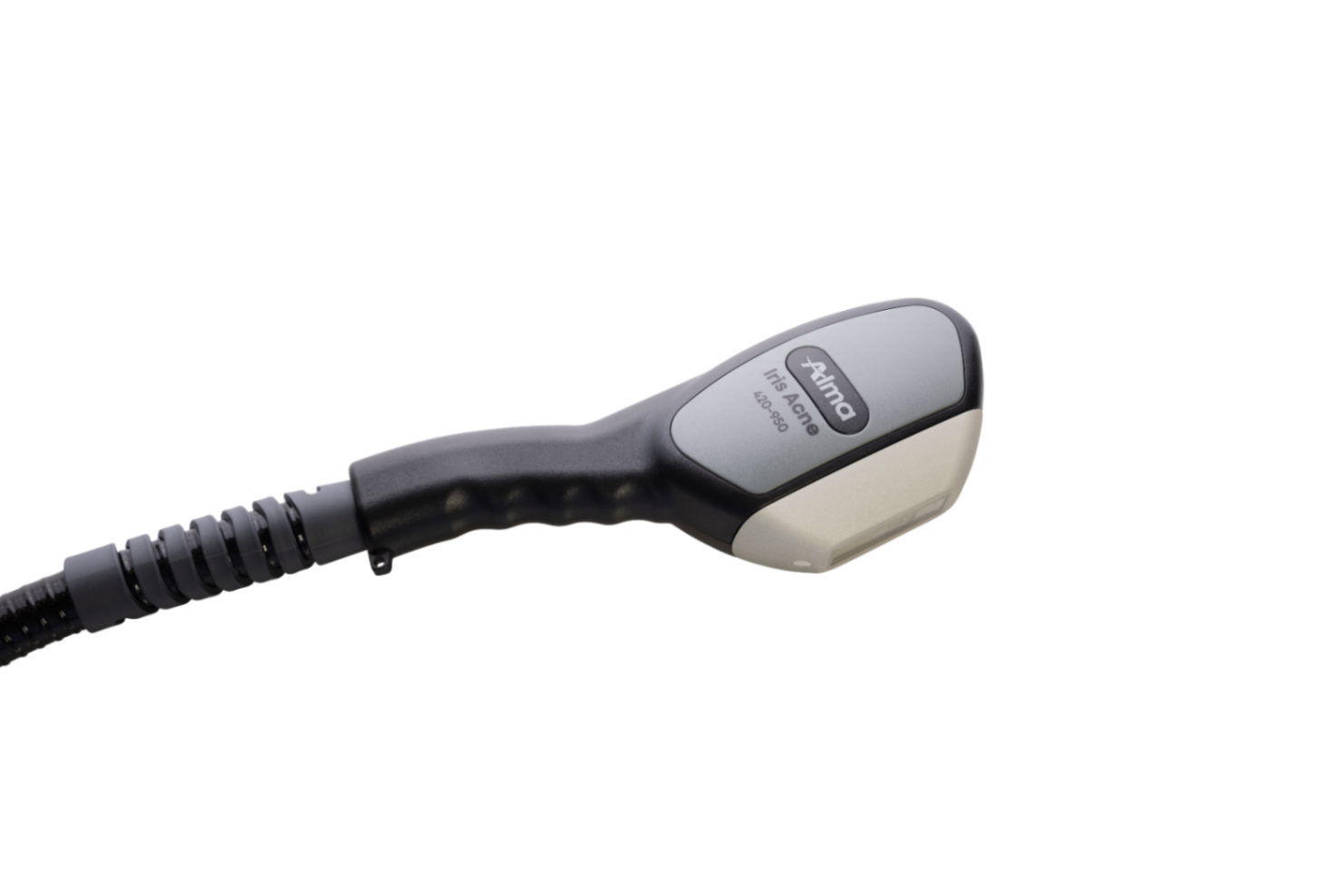
IRIS Acne (IPL, 420 to 950 nm) This applicator delivers a broad band of light, from blue through to near-infrared. Light in the blue range can be absorbed by porphyrins produced by acne bacteria, while longer wavelengths penetrate more deeply and are aimed at the inflammatory side of acne. In the US it is cleared for the treatment of moderate inflammatory acne vulgaris.
ClearSkin Pro (1540 nm non-ablative Er:Glass laser) ClearSkin Pro delivers heat into the dermis, where oil glands sit, while leaving the surface of the skin intact. Alma describes it as the first technology to combine a non-ablative laser with simultaneous contact cooling and vacuum. The combination of cooling and vacuum is designed to protect the skin's surface and improve comfort. We use ClearSkin with both its fractional and CVD tips, which lets us tailor treatment to active breakouts or to texture.
Superb 2940 (Er:YAG ablative laser) For established indented scarring, this ablative laser creates tiny controlled columns of injury that stimulate new collagen and remodelling. You can read more about it in our blog on ablative resurfacing.
What does the research say?
The overall picture for light therapies is mixed. A Cochrane systematic review, widely regarded as the gold standard of evidence, concluded that high-quality evidence on light therapies for acne is lacking and that firm conclusions could not be drawn. We think it is important you know that.
1540 nm erbium glass for active acne: in a study of 15 patients with moderate to severe acne treated four times at two-week intervals, the investigator-assessed improvement at six months was 78%, with no significant side effects and no need for anaesthetic. A review of laser treatments for active acne concluded that lasers are a useful treatment option and an adjunct to medical treatment, while noting that many studies are small and lack control groups.
Dual-band IPL for active acne: in a small prospective study of 10 patients across skin types II to V, five sessions of dual-band IPL led to half of the patients achieving at least a 50% reduction in lesions at four weeks, with minimal downtime.
1540 nm fractional laser for acne scars: a randomised controlled trial with blinded assessment found that laser-treated scars appeared smoother and more even than untreated control areas, with improvement maintained at 12 weeks. Temporary redness, swelling and crusting were expected, but there were no lasting complications.
ClearSkin Pro for texture: a study using ClearSkin Pro over five monthly sessions in 15 people found skin roughness volume reduced by 49.5%, with 24 to 48 hours of downtime and no serious side effects.
Ablative Er:YAG for deeper scars: in a split-face trial in skin type IV, fractional Er:YAG and CO2 lasers produced comparable scar improvement, but Er:YAG was significantly less painful and caused post-inflammatory hyperpigmentation less often (35% versus 50% of treated sites).
Why a medical setting matters for acne
Acne is a medical condition, and treatment should be joined up with any medication you are taking. Some acne medicines affect how the skin heals, and this needs to be taken into account when planning laser treatment.
Pigment risk. Acne-prone skin, especially in deeper skin tones, is prone to post-inflammatory hyperpigmentation. We tailor settings to your skin type and prepare the skin carefully.
The right tool for the right stage. Active inflammation, red marks, brown marks and true scars each need a different approach. Our OBSERV 520x skin analysis helps us see what is really going on.
What to expect
Consultation: skin analysis, full medical and acne history, and a clear discussion of what can realistically be achieved.
Active acne: usually a course of sessions a few weeks apart, alongside a suitable skincare routine.
Scarring: scars improve gradually as new collagen forms over several months. Improvement is typically partial rather than complete, and a course of treatments is usually needed.
Downtime: varies from very little with IPL, to a day or two with ClearSkin Pro, to several days with ablative Er:YAG.
Let's talk about your skin
Whether you are dealing with breakouts now or the marks they left behind, book a consultation at DG Medical Aesthetics and Skin. We are a CQC-registered, nurse-led clinic, and we will give you honest, evidence-based advice about what will help.
This article is for general information and does not replace a personal consultation. Results vary between individuals.