
Dermal Fillers vs Skin Boosters vs Profhilo vs SkinVive: A Nurse’s Comparison
Four treatments, one main ingredient, and a lot of confusion. Dermal fillers, skin boosters, Profhilo and SkinVive all use hyaluronic acid, so people assume they do the same job. They do not. Here is how a nurse-led clinic separates them.

Hyaluronic acid is a substance your skin already produces. It holds water, keeps tissue plump, and declines as you age. Almost every popular injectable skin treatment uses a form of it, which is exactly why patients arrive at consultation unsure which one they actually need. The names get used interchangeably online, and the marketing rarely makes the distinction clear.
The simplest way to hold the difference in your head: dermal fillers add structure, and the other three improve skin quality. A filler restores volume and contour where tissue has been lost. Skin boosters, Profhilo and SkinVive do not change the shape of your face. They work on hydration, texture and the overall condition of the skin itself. Beyond that headline, each has its own behaviour, longevity, and ideal use, which the table below sets out side by side.
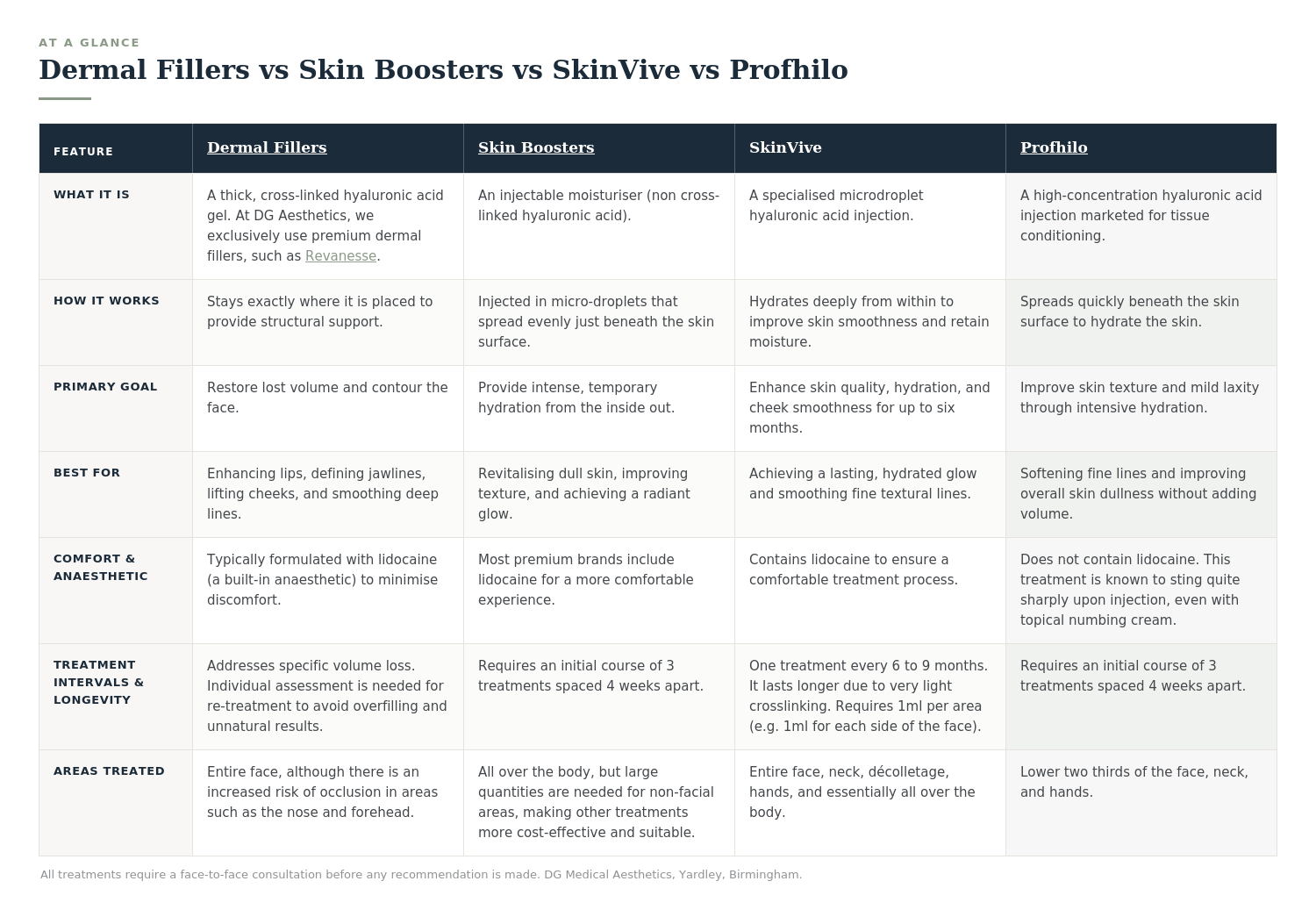
Dermal fillers: structure and contour
Dermal filler is the only treatment of the four that changes the shape of your face. The gel is cross-linked, which means it holds its form and stays where the nurse places it. That property is what lets it restore a flattened cheek, define a soft jawline, or rebuild a lip that has lost its border. It does not improve the quality of the skin across a wide area. It does one thing well, which is replace lost structure at a specific point.
Because filler holds its position, placement matters more than with any other treatment here. Our nurses assess the whole face before treating a single area, since volume loss in one place often explains a problem somewhere else. You can read how we approach this on our dermal fillers page, and for lips specifically on our lip filler page.
Skin boosters: hydration across an area
Skin boosters move in the opposite direction to filler. The hyaluronic acid is not cross-linked, so rather than holding a shape it spreads through the tissue and draws in water. The goal is condition, not contour. Patients choose boosters when the skin looks dull, feels dry, or has lost its surface quality, rather than when a specific area needs rebuilding. The trade-off is that the effect is more temporary, which is why the standard plan is a short initial course. Our skin boosters page covers the options we use.
Profhilo: bio-remodelling, not a filler
Profhilo sits in its own category. It uses one of the highest concentrations of stabilised hyaluronic acid of any injectable, delivered to a small number of precise points where it then spreads. It hydrates, but it also stimulates the skin to remodel itself over a course of treatment, which is why it is described as bio-remodelling rather than filling or boosting. It suits skin that has started to lose firmness in the lower face, neck and hands. Worth knowing before you book: Profhilo contains no lidocaine, so the injections sting more sharply than the other treatments here. Full detail is on our Profhilo page.
SkinVive: the newer microdroplet option
SkinVive is the most recent arrival of the four. It is a microdroplet hyaluronic acid injection designed to improve skin smoothness and hold hydration, with results lasting up to six months from a single treatment per area. It covers the widest range of areas, from the face through to the hands and body. We do not yet have a dedicated page for SkinVive, so the right place to ask about it is at consultation.
Which one is right for you?
If you want to rebuild volume or change a contour, that is filler territory. If your skin is healthy in shape but poor in condition, a skin booster, Profhilo or SkinVive is the more honest answer, and the choice between those three comes down to the degree of laxity, the areas you want treated, and how long you want results to last. None of this can be decided from a table or a blog post. The right treatment depends on your skin, your medical history, and what you actually want to change, which is why we assess every patient face to face before recommending anything.
Talk it through with a nurse
DG Medical Aesthetics is a CQC-registered, nurse-led clinic in Yardley, Birmingham, 15 to 20 minutes from Solihull via the A45. Every treatment is assessed and carried out by Donna Gibson and Kerry Gibson-Harris, registered nurses with over 25 years of combined NHS and aesthetic experience. Book a consultation. No treatment is carried out at a first visit; a full clinical consultation is required first.