
Redness, Thread Veins and Rosacea: A Clear-Headed Guide to Laser Treatment
Do you find yourself reaching for colour-correcting primer every morning? Do people ask whether you have been out in the cold, or whether you are embarrassed, when you feel perfectly fine? Facial redness is incredibly common, particularly from our late thirties onwards, and it can be surprisingly hard to hide.
Redness usually comes down to blood vessels: either lots of tiny dilated vessels creating a flush, or individual visible "thread veins" (the medical term is telangiectasia). Laser and light treatments are among the most effective ways to reduce them. Here is how they work, what the evidence says, and why who treats you matters.
Understanding what is behind the redness
Thread veins (telangiectasia): fine red or purple vessels, commonly around the nose and cheeks. Sun damage, genetics, age and skin trauma all play a part.
Rosacea: a chronic inflammatory skin condition. It can cause flushing, persistent central facial redness, visible vessels, and in some people bumps and pustules. Triggers often include heat, alcohol, spicy food, stress and sunlight.
Sun-damaged skin: redness is often mixed with brown pigmentation, giving a blotchy, uneven appearance.
Leg thread veins: fine vessels on the legs, which tend to be deeper and harder to treat than those on the face.
It is important to be clear from the outset: rosacea cannot be cured, by laser or anything else. What laser and light can do very effectively is reduce the visible vessels and background redness that creams often struggle to shift.
How laser targets redness
Blood contains haemoglobin, which absorbs certain wavelengths of light strongly. When we select the right wavelength and pulse, the energy is absorbed by the blood in the vessel, heating it so that the vessel wall is damaged and gradually reabsorbed by the body, while the surrounding skin is spared as much as possible. This principle, selective photothermolysis, has underpinned vascular laser treatment for over 40 years.
Three tools for three types of vessel
Vessels vary in size, depth and colour, so one device does not suit all. Our Alma Harmony platform gives us three dedicated options.
Dye-VL (narrow-band IPL, 500 to 600 nm) Best for diffuse redness, flushing and clusters of fine vessels across the cheeks and nose. It covers a larger area with each pulse and also addresses brown sun damage at the same time. In the US it is cleared for benign vascular and pigmented lesions in skin types I to V.
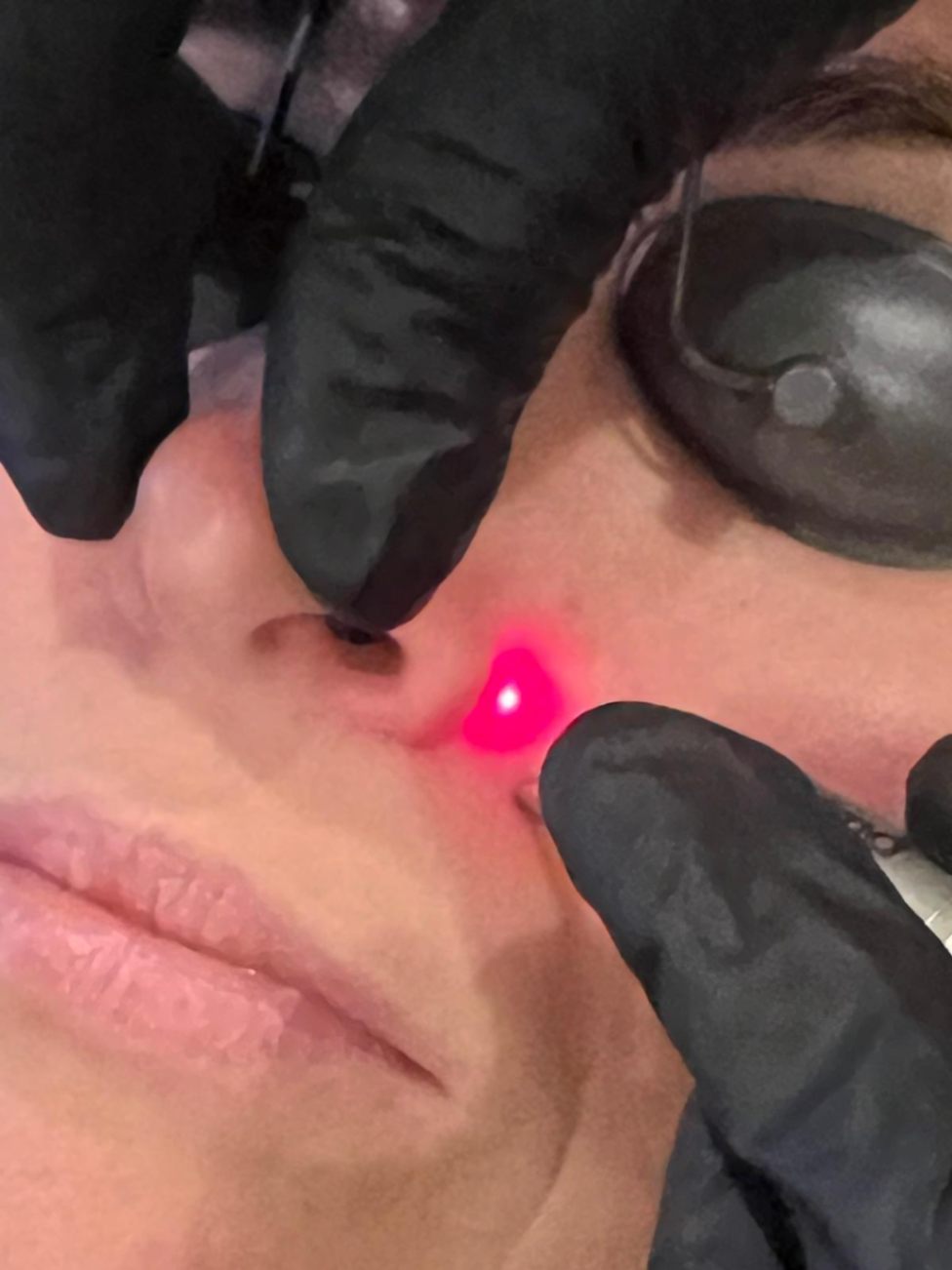
VascuPen (520 nm green diode laser) A precise, pen-style laser designed for detailed vascular work, such as individual thread veins around the nose. Its small, targeted beam allows us to trace fine vessels accurately.
ClearVas (long-pulsed 1064 nm Nd:YAG) This longer wavelength penetrates more deeply, making it suitable for larger, deeper or bluish vessels, including some leg veins, where surface-level green or yellow light would not reach.
What does the research say?
Rosacea redness and visible vessels: a systematic review in the British Journal of Dermatology, which graded the quality of evidence for rosacea treatments, found low to moderate certainty evidence that pulsed dye laser, Nd:YAG laser and IPL improve persistent redness and telangiectasia. The reviewers noted that trials were often small. In other words, the treatments are widely used and generally supported, but there is room for larger, better studies.
IPL for rosacea: a UK study published in the British Journal of Dermatology treated 34 patients with early-stage rosacea using four IPL sessions three weeks apart. Photographic assessment showed a 46% improvement in redness and a 55% reduction in telangiectasia, with results maintained at six months and only minimal, short-lived side effects.
Narrow-band "dye" pulsed light: in a study of 65 patients with redness-predominant rosacea, three sessions four weeks apart produced significant improvement in redness and visible vessels. Interestingly, milder telangiectasia responded better than severe, which is one reason we encourage people not to wait years before seeking treatment.
Choosing the right wavelength: a comparison of 532 nm green laser and 1064 nm Nd:YAG for cherry angiomas (small red vascular spots) found both were effective. The 1064 nm laser needed fewer sessions but carried more risk of discomfort and scarring, while the green laser was gentler overall but was associated with more hyperpigmentation; the authors suggested 1064 nm may be preferable in darker skin. This is exactly the kind of trade-off a practitioner needs to understand when matching the device to your skin.
Why a medical setting matters for redness
Rosacea is a medical condition. Some people need prescribed treatment alongside laser, particularly if they have bumps and pustules or eye symptoms. As nurses, we can recognise this and work alongside your GP.
Skin type and safety. Wavelengths that target blood can also be absorbed by melanin. Assessing your skin type, recent sun exposure and medications carefully helps us minimise the risk of burns or pigment changes.
Honest advice about legs. Leg veins are more challenging than facial veins. If laser is not the best option for your particular veins, we will tell you.
What to expect
Consultation and skin analysis using our OBSERV 520x imaging, which can reveal underlying redness and vascular patterns.
During treatment: a warm snap, often described like a flick from an elastic band. Treatment sessions are usually quick.
Afterwards: temporary redness and mild swelling are common and usually settle within a few days. Some fine vessels disappear immediately; others fade over the following weeks.
A course of treatment: most people need a series of sessions, typically spaced three to four weeks apart, and rosacea may need occasional maintenance.
Daily SPF and trigger management help protect your results.
Take the first step
If redness or thread veins are making you self-conscious, book a consultation at DG Medical Aesthetics and Skin. We are a CQC-registered, nurse-led clinic offering discreet, personalised treatment planning, and we will always give you an honest view of what laser can achieve for you.
This article is for general information and does not replace a personal consultation. Results vary between individuals.